 Skip to content
Global Galvanized Wire Standards: Analyzing ASTM A153 and DIN Requirements for Industrial Projects
In major civil and industrial projects, the selection of high-quality base materials determines the boundary between the longevity of a structure and its premature failure. Galvanized wires, being one of the most widely used steel cross-sections in armoring, fencing, gabion manufacturing, and armor cables, are constantly exposed to mechanical stress and corrosive attacks. For a site engineer or project manager, approving the quality of these products is not possible merely through visual inspection; rather, strict compliance with global galvanized wire standards such as American (ASTM) and European (DIN and EN) codes guarantees their long-term performance.
In this comprehensive article, we will expertly examine the technical requirements, mechanical tests, and chemical analysis of galvanized wires based on international codes to provide a documented reference for the decision-making of supervising engineers, quality control teams, and contractors.
The Importance of Galvanized Wire Standards in Industrial Projects
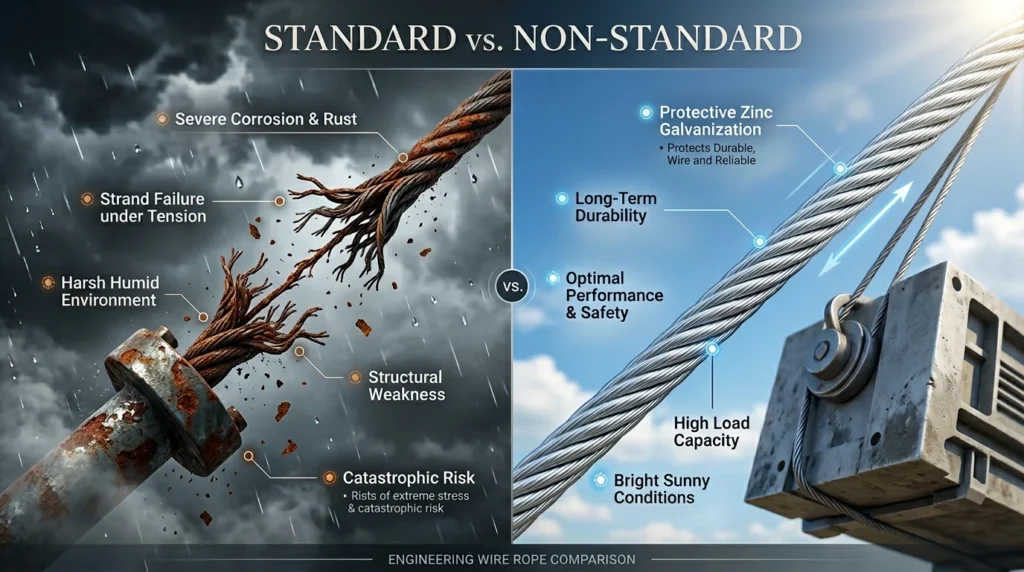
In diverse climates, especially in regions with high humidity and salinity like the UAE and the broader Middle East coastlines, the metallurgical behavior of steel wires changes drastically. International standards are formulated precisely to predict and control these physical and chemical behaviors. Using wire produced without adhering to coating standards in corrosive environments leads to rapid rusting (oxidation), reducing the cross-sectional area and endangering the tensile strength of the entire structure or fence.
From a legal and economic perspective, supervising engineers bear direct responsibility for approving materials. In the event of incidents caused by cable ruptures, gabion mesh failures, or galvanized armature rusting, the first document reviewed by legal authorities is the Quality Control Certificate and the product’s compliance with standards like ASTM and DIN. Therefore, mastering these standards not only ensures project quality but also serves as a legal shield for the engineering team.
Q: Are global standards also applicable for retail buyers (e.g., farmers or small contractors)?
Yes. Although farmers or orchard owners fencing their lands do not need to master complex metallurgical tables, knowing that the purchased product has a valid certificate assures them that their investment will withstand weathering for at least 20 to 30 years without the need for costly early replacements.
Q: What is the main difference between local national standards and global standards in the wire industry?
Many national standards are essentially localized versions of reputable global standards (mostly DIN Germany and ASTM USA). However, in sensitive industrial and international projects, directly referring to the original international codes is preferred to prevent any misinterpretation.
Recognizing and applying global standards when purchasing and approving galvanized wires is an engineering and legal requirement. By precisely defining production parameters, these codes minimize the risk of premature structural failure in various climates and guarantee the project’s economic viability in the long term.

Analytical Review of ASTM A153 and Galvanized Coating Requirements
The American Society for Testing and Materials (ASTM) standard is one of the most authoritative references in the steel industry. In the field of galvanization, the ASTM A153 standard specifically addresses zinc coatings applied to iron and steel hardware via the hot-dip process. This standard sets requirements for coating weight, uniformity, adherence, and the final visual appearance of the product.
In addition to A153, specialized applications involve other standards. For instance, low-carbon steel armor wires used in cable manufacturing must meet ASTM A411 requirements. Meanwhile, for more advanced coatings like the 5% Aluminum-Misch metal alloy (Galfan), engineers refer to the ASTM A856 standard.
One of the most critical tests in these standards is the “Adherence of Coating” test. In this test, the wire is wrapped around a mandrel of a specific diameter to determine if the zinc layer flakes off the steel surface. If the adhesion is weak, the galvanized coating will break during wire bending on-site, opening the path for moisture penetration and initiating corrosion.
Q: How is the galvanized coating weight calculated and evaluated in the ASTM standard?
Coating weight is calculated in grams per square meter $(gr/m^{2})$. Depending on the wire’s diameter and type, a minimum coating weight is specified. For example, in certain thick armor wires, this coating must be a minimum of 230 $gr/m^{2}$ to offer the highest level of cathodic protection, whereas Galfan coatings for similar diameters may require a minimum of 170 $gr/m^{2}$ due to the superior protection of the aluminum-zinc alloy.
Q: Does the ASTM standard also control the visual appearance of the wire?
Yes. According to ASTM requirements, the galvanized wire’s surface must be free from sharp protrusions, blisters, uncoated (bare) spots, and massive zinc deposits. A uniform surface guarantees both aesthetic appeal and an even distribution of corrosion resistance.
The ASTM standard family, particularly A153, A411, and A856, guarantees the quality of the wire’s protective layer by pinpointing coating weights and conducting rigorous adhesion tests. Adhering to these requirements is vital to prevent corrosion in areas subjected to bending and stress.

European DIN and EN Standards: Precision in Chemical and Mechanical Analysis
Alongside American standards, European systems such as DIN (German Institute for Standardization) and EN (European Standards) are highly utilized in international industrial projects. Specifically, for galvanized steel wires and their coatings, BS EN 10244-2 (for coatings) and BS EN 10257-1 serve as primary quality control references.
These standards focus heavily on the chemical composition of the initial wire rod and the physical-mechanical properties after drawing and galvanization. Excessive impurities can severely impact the product’s flexibility and tensile strength. The table below illustrates common chemical and physical requirements for low-carbon galvanized steel wires (approx. 2.20 mm diameter) based on these codes:
Control Parameter | Limit / Standard Range | Importance in Industrial Performance |
Carbon (C) | Max 0.1% | Maintains softness and flexibility for weaving meshes. |
Manganese (Mn) | Max 0.4% | Increases strength and toughness without reducing flexibility. |
Phosphorus (P) | Max 0.035% | Prevents steel brittleness in cold environments. |
Sulfur (S) | Max 0.035% | Reduces impurities and prevents cracking during bending. |
Silicon (Si) | Max 0.15% | Controls surface quality and improves the galvanization process. |
Tensile Strength | 340 to 500 $N/mm^{2}$ | Endures static and dynamic loads in structures. |
Elongation | Min 10% | Ensures sufficient stretching capacity before failure. |
Wrapping Test | OK (No cracking/flaking) | Confirms the steel structure won’t fail at knots and twists. |
Q: Why is the control of Phosphorus and Sulfur in chemical analysis so strict?
Phosphorus and Sulfur are known as destructive elements in steel. Sulfur causes “Hot Shortness” and Phosphorus causes “Cold Shortness”. If these elements exceed the 0.035% threshold, the wire can easily snap during production or when used in extreme temperature fluctuations.
Q: What exactly does the Wrapping Test show a supervising engineer?
In this test, the wire is wrapped multiple times around itself or an equal-diameter axis. If the wire’s steel core does not tear or crack during this twisting, it indicates proper heat treatment (annealing) and high quality of the base material, which is crucial for applications like gabion assembly.
EN and DIN standards ensure the structural integrity of the wire by strictly controlling chemical analysis (limiting destructive elements) and executing physical tests like tensile and wrapping tests. This metallurgical precision is the foundational requirement for producing flexible and robust wires.

Operational Guide for Supervisors: Quality Control of Galvanized Wire on Site
For a site engineer, the theory of standards is valuable only when it can be implemented and controlled in the site environment. Upon the arrival of a galvanized wire shipment to the site, the first step is a meticulous review of the product certificate. This certificate must include a product identification number so that traceability is maintained until final consumption.
Supervisors must compare the numbers on the certificate with standard codes. For instance, for a wire with a nominal diameter of 2.20 mm, the standard tolerance is between 2.15 and 2.25 mm. A visual inspection to ensure the absence of white rust (zinc oxidation) and a uniform, shiny coating is also mandatory.
In this regard, reliable suppliers act as the executive arm of quality control. Project engineers and procurement managers can contact the experts at APIT to verify the authenticity of technical certificates, request current pricing, and receive specialized consulting to select the best wire grade suited for their project conditions in the Middle East.
Q: How can wire quality be assessed if no laboratory equipment is available on site?
In addition to demanding a valid certificate from the supplier, simple on-site tests can be performed. Wrapping the wire tightly around itself with pliers and observing the coating’s behavior (lack of severe zinc flaking), as well as checking its flexibility, are quick empirical methods on site.
Q: What is the concept of Traceability in wire quality control?
Traceability means every wire coil has a label and Batch Number allowing access to its production date, work shift, raw material chemical analysis, and mechanical test results for that specific batch. This is highly effective in tracking potential defects.
Effective quality control on-site requires a close examination of standard certificates, dimensional tolerance matching, and preliminary visual/physical tests. Partnering with reputable, certified suppliers like APIT lifts a massive legal and technical burden off the shoulders of supervising engineers.

Economic and Legal Justification of Purchasing Based on International Standards
A constant challenge in projects is managing budget and cash flow. Sometimes contractors lean towards buying “commercial” or non-standard wires to reduce initial costs. However, economic analyses prove this is a strategic error. Non-standard wires suffer from weak galvanized coatings (low zinc weight) and lack of uniformity, leading to deep corrosion in just a few years.
The costs associated with halting a project to fix fences, replace armor cables, or demolish concrete due to rusted galvanized rebar are tens of times higher than the initial purchase price difference. Legally, in the event of any physical or financial damage resulting from structural failure, the supervisor and contractor who approved the non-standard materials will be held liable.
To prevent these irreversible risks and intelligently manage project budgets, APIT offers free consultation to contractors and procurement managers. We help strike a balance between technical requirements (like DIN and ASTM standards) and approved budgets to supply the most economical and safest options.
Q: Is hot-dip galvanized wire always more expensive than cold (electro) galvanized wire? What justifies buying it?
Yes, the hot-dip galvanization process costs more due to the significantly thicker zinc layer. However, the justification lies in the product’s lifespan; hot-dip galvanized wire resists moisture for decades, whereas cold galvanized wire oxidizes rapidly outdoors. Buying hot-dip products is essentially pre-purchasing structural longevity.
Q: What should be done if the wire certificate contradicts third-party laboratory results?
In professional contracts, the final criteria are the results from reputable, independent laboratories. If discrepancies exceed standard tolerances, the buyer has the right to return the shipment and claim damages for work stoppage. This highlights the necessity of verifying the manufacturer’s credibility prior to purchase.
Purchasing standard galvanized wire is not a mere expense but an investment to mitigate legal risks and eliminate exorbitant future maintenance costs. Transparency in certification ensures the financial and legal security of the contracting team.

Comprehensive Reference of Galvanized Wire Standard Codes
To prevent confusion among engineers dealing with a multitude of figures and to create a quick reference for on-site inspections, the technical team at APIT has compiled a summary of the most critical standard codes categorized by international authorities in the tables below.
American Society for Testing and Materials (ASTM) Codes
The ASTM family of standards is the most widely used reference in oil, gas, petrochemical, and heavy industry projects:
Standard Code | Standard Title and Subject | Primary Industrial Application |
ASTM A641 / A641M | Standard Specification for Zinc-Coated (Galvanized) Carbon Steel Wire | Base standard for various commercial and industrial galvanized wires. |
ASTM A153 / A153M | Zinc Coating (Hot-Dip) on Iron and Steel Hardware | Quality control for weight and thickness of coating on steel parts. |
ASTM A411 | Zinc-Coated (Galvanized) Low-Carbon Steel Armor Wire | Mechanical protection of underground power, telecom, and fiber optic cables. |
ASTM A856 / A856M | Zinc-5% Aluminum-Mischmetal Alloy-Coated Carbon Steel Wire (Galfan) | Used in highly corrosive environments and specialized gabion production. |
ASTM A116 | Metallic-Coated, Steel Woven Wire Fence Fabric | Fencing for large projects, agricultural lands, and pastures. |
ASTM A392 | Zinc-Coated Steel Chain-Link Fence Fabric | Production of standard chain-link fences for landscaping. |
European (EN) and German (DIN) Standard Codes
These standards place a very high focus on dimensional tolerances, mechanical tests, and wire surface quality in construction projects:
Standard Code | Standard Title and Subject | Primary Industrial Application |
BS EN 10244-2 | Non-ferrous metallic coatings on steel wire | The most critical European standard for assessing galvanized layer quality. |
BS EN 10257-1 | Zinc or zinc alloy coated non-alloy steel wire for armoring | Similar to ASTM A411, used for cable armoring in Europe. |
BS EN 10223-2 | Steel wire and wire products for fences – Hexagonal steel wire netting | Manufacturing standard for hexagonal meshes and gabions. |
BS EN 10223-6 | Steel wire and wire products for fences – Chain link fencing | Quality control for wires used in chain-link fence production. |
DIN 1192 | Low carbon steel wires | General German standard for base drawn wires. |
💡 Expert Tip: If you need to match your project materials with any of the above standard codes, be sure to request technical documents and product catalogs from APIT experts before placing an order to ensure full compliance with your project requirements.

Final Conclusion and the Path Forward
Guaranteeing the durability and stability of industrial structures is directly tied to the quality of the consumed materials. As reviewed in this article, global galvanized wire standards like ASTM A153, A411, A856, and the EN series provide a flawless framework for controlling chemical composition, tensile strength, coating weight, and final product quality. For site engineers, relying on these standards means achieving zero-error material approvals and maintaining professional credibility before clients and legal authorities.
Choosing a supplier that understands the engineering and quality concerns of your project is the key to successful industrial procurement. APIT, as a specialized supplier of welding electrodes and galvanized/industrial wires based in Dubai, stands by you with products complying with the strictest international standards, backed by valid laboratory certificates. We recommend contacting the technical experts at APIT today to better manage your project’s time and budget, injecting lasting quality into your structures with absolute peace of mind.

Discussion
Start the conversation